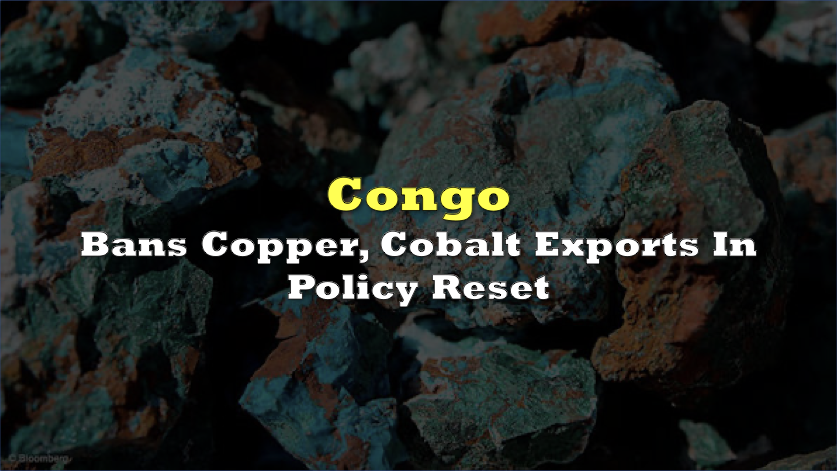

The Democratic Republic of Congo has replaced its 2023 mineral-export framework with a broader order that keeps copper and cobalt concentrates inside the country, resets the exemption system, and brings additional mining by-products into the royalty base.
The June 29 directive prohibits concentrate exports immediately but allows the mines minister to grant one-year waivers under undefined “strategic” circumstances. It also introduces a three-month transition period for a new tax regime covering economically significant by-products, according to an order reviewed by Reuters.
Copper prices reacted more sharply than the country’s current export mix may warrant. Three-month copper on the London Metal Exchange rose as much as 1.8% to $14,369.50 per metric ton after the order was reported, reaching its highest level since January 29.
 Sponsored · Mercado Minerals Ltd.
Congo exported 696,725 tonnes of copper cathodes during the first quarter of 2026, compared with 53,926 tonnes of concentrate containing 18,863 tonnes of copper metal, according to official figures cited by Reuters. Cathode volumes were roughly 37 times the contained copper shipped in concentrate.
That export mix limits the order’s immediate reach across most of the industry. Much of Congo’s copper is already processed domestically into cathodes, anodes, or blister copper before shipment.
The prohibition itself also predates the latest order. Congo introduced a concentrate export ban in 2013 and subsequently issued a series of moratoriums as operators faced insufficient electricity and domestic smelting capacity. A 2023 order again prohibited copper and cobalt concentrate exports while allowing one-year exemptions based on technical or economic considerations.
The June 29 directive repeals that 2023 framework and its exemptions, Reuters reported, while preserving the government’s ability to approve new one-year waivers.
 Sponsored · Selkirk Copper Mines
Kamoa’s exposure
Mining analyst Christian-Geraud Neema told Reuters that most operators were unlikely to face severe disruption because their output is already processed locally. He identified Kamoa-Kakula, owned by Ivanhoe Mines, Zijin Mining, and the Congolese government, as potentially more exposed because it has previously exported concentrate under exemptions.
Ivanhoe’s latest disclosures show that exposure has declined since its on-site smelter entered production. During the first quarter, Ivanhoe said all Kamoa-Kakula concentrate was processed either at its own smelter or at the Lualaba Copper Smelter in Kolwezi. The company exported only 99.7%-pure copper anodes during the quarter, reducing logistics costs to $0.22 per pound from $0.70 per pound in Q4 2025.
Kamoa-Kakula produced 61,134 tonnes of copper in concentrate during the second quarter. Its on-site smelter produced 62,072 tonnes of copper in anode, while the Lualaba facility produced another 2,256 tonnes in blister. The project ended June with approximately 40,000 tonnes of contained copper in inventory and plans to reduce that balance to between 25,000 and 30,000 tonnes by year-end.
Ivanhoe has not said how the new order affects that planned inventory reduction or any saleable slag concentrate.
By-product taxes
The less visible change is the new treatment of minerals recovered alongside a mine’s principal product. Reuters reported that trace and ultra-trace minerals recovered during refining will be assigned a 55% valuation coefficient. Royalties would be assessed on those by-products in addition to the royalty charged on the principal mineral.
Operators must begin declaring the relevant substances immediately, although the taxation framework has a three-month transition period.
The concentrate rules are also separate from Congo’s cobalt quota system, replaced a broader cobalt export suspension in October 2025 and capped exports at 96,600 tonnes annually for 2026 and 2027.
The policy reset comes less than one month after President Félix Tshisekedi warned revenue agencies that unpredictable charges, account seizures, and asset freezes were increasing mining costs and weakening investor confidence. He ordered authorities to prioritize legally defined procedures, dialogue, and conciliation.
The June order now places the burden on Congo’s ministries to show that tighter value-capture rules can be enforced without recreating the regulatory uncertainty the president had just instructed them to reduce.