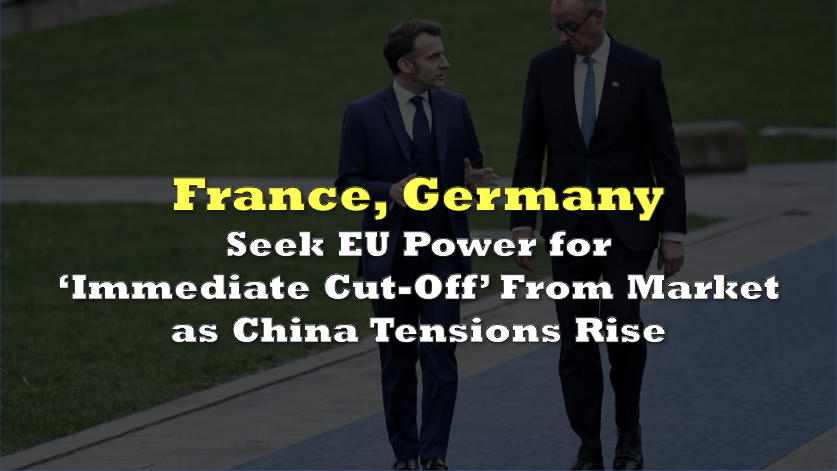

Germany has moved from trying to stop EU tariffs on Chinese electric vehicles to backing a trade mechanism that would make sweeping European retaliation harder for member states to block, marking a sharp change in Berlin’s approach to economic pressure from China.
French President Emmanuel Macron and German Chancellor Friedrich Merz sent European Commission President Ursula von der Leyen a joint letter and policy paper proposing a new rapid-response trade instrument. The mechanism could authorize measures reaching an “immediate cut-off from the internal market if needed,” according to the letter, which was reported by Reuters and obtained by the South China Morning Post.
The institutional change may be as significant as the possible sanctions. Paris and Berlin want the mechanism activated through a reversed qualified-majority procedure, meaning Commission action could proceed unless enough EU governments assembled a qualified majority to oppose it. Reuters reported that creating the instrument would still require legislation approved by member states and the European Parliament.
 Sponsored · Selkirk Copper Mines
Neither document names China, and the proposal says the tool should be country-agnostic. The policy paper nevertheless targets problems that have become central to the EU’s dispute with Beijing, including excess industrial capacity, subsidies, dumping, currency distortions, and concentrated supply chains.
This position represents a notable reversal for Germany. In October 2024, Berlin voted against the EU’s additional duties on Chinese-made electric vehicles, joining four other countries in opposition while France voted in favor. The tariffs still passed because opponents failed to assemble the qualified majority required to block them.
Trade pressure has intensified since then. Eurostat recorded €559.4 billion of EU goods imports from China in 2025 against €199.6 billion of exports, producing a €359.8 billion deficit. Imports rose 6.4% from 2024 while EU exports to China fell 6.5%. In September, von der Leyen described the gap as roughly €1 billion per day.
The Franco-German package also proposes a diversification instrument aimed at reducing supply-chain dependence, faster and broader trade-defense investigations, wider use of sector safeguards, and targeted action covering areas including chemicals, PET plastics, and plug-in hybrid vehicles. It also calls for stronger enforcement against circumvention and more resources for EU trade-defense investigations.
The basic idea was already public before Monday. Reuters reported previously that France and Germany were preparing a mechanism modeled in part on the leverage of US Section 301 trade powers. Beijing responded by warning it would “resolutely respond” to discriminatory measures.
The proposal now lands ahead of EU Trade Commissioner Maros Sefcovic’s expected talks with Chinese Commerce Minister Wang Wentao in Beijing and a European Council meeting scheduled for October 15-16.