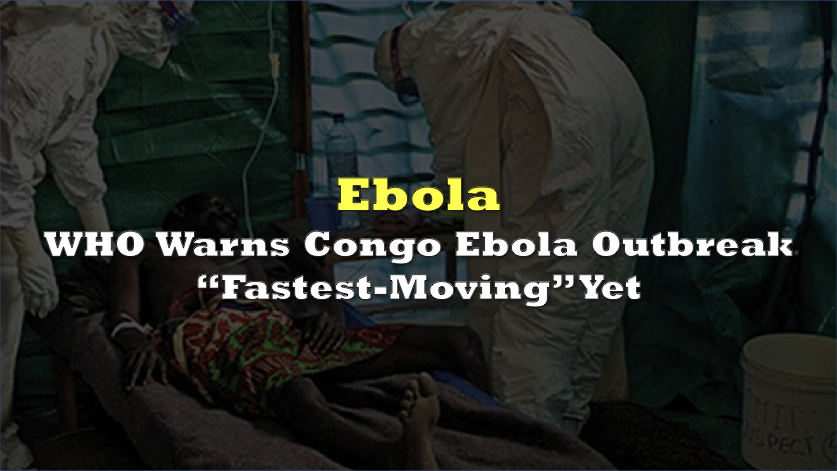

The World Health Organization says the response to the Democratic Republic of the Congo’s Ebola outbreak is still operating behind the epidemic’s pace, even as authorities prepare to triple treatment capacity and seek hundreds of millions of dollars to contain what is already the country’s largest recorded outbreak.
WHO Director-General Tedros Adhanom Ghebreyesus said that 4,449 confirmed cases and 2,061 deathshad been recorded across five provinces and 53 health zones. At roughly 46%, the confirmed-case fatality rate remains near the historical average for Ebola disease.
“At its current pace, it is on track to eclipse the West African Ebola outbreak of 2014 to 2016,” Tedros said. He called the current epidemic the second-biggest on record and the fastest-moving Ebola outbreak yet.
 Sponsored · Selkirk Copper Mines
The 2014–2016 West Africa epidemic infected more than 28,600 people and killed more than 11,300, according to WHO.
WHO’s July 30 update listed 3,605 confirmed cases and 1,587 deaths in Congo. By August 11, the totals had increased by 844 cases and 474 deaths, or roughly 23% and 30%, respectively, in less than two weeks.
The agency said about 90% of current cases and 80% of deaths are concentrated in Ituri province. It also flagged a high share of deaths occurring in communities rather than treatment units and outside known contact lists, a pattern WHO says indicates transmission chains are still being missed.
WHO said contact tracing is running at around 80%, below the 95% target it says is needed to interrupt transmission. Authorities and partners are also working to increase treatment capacity to 3,000 beds within 12 weeks and recruit three health workers for every patient.
More than 21,000 community health workers have been trained, while 886 patients have recovered, according to WHO. There are still no approved vaccines or specific treatments for disease caused by the Bundibugyo virus responsible for the outbreak, although vaccine and therapeutic trials are underway.
Two Bundibugyo-specific vaccine candidates have entered phase one human safety trials. WHO also recommended moving a vaccine designed for the more common Zaire ebolavirus into a phase three trial after animal studies suggested possible cross-protection.
The agency cautioned that efficacy against Bundibugyo disease in humans has not been established.
The scale-up also faces a financing constraint. WHO said the Continental Preparedness and Response Plan requires $518 million, of which $264 million, or just over half, has been disbursed.
In July, WHO separately said it had received about 40% of a narrower $115 million appeal focused on its response. Conflict in eastern Congo, population displacement, limited health-care access, and community mistrust have continued to complicate surveillance and containment.