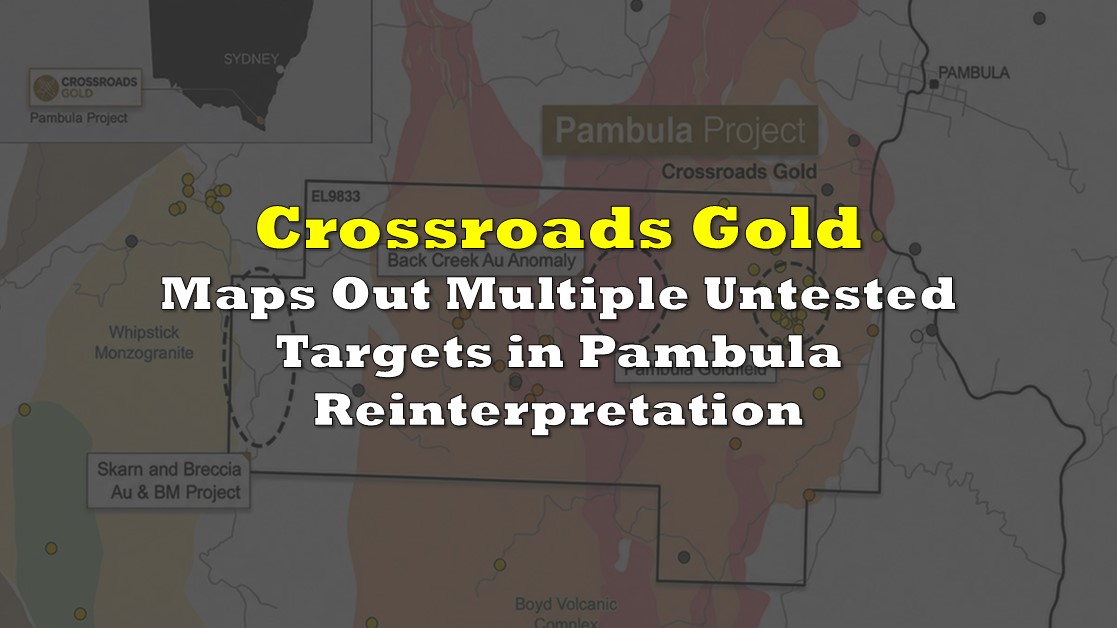

Crossroads Gold (TSXV: CRG) has completed a historical data compilation and geological reinterpretation of its Pambula Gold Project in New South Wales, Australia, a study the company says points to a district-scale hydrothermal gold system with multiple untested targets.
The work pulled mining records, geological survey data, structural interpretations and historical production figures into a single modern exploration framework. The picture that emerges is of a goldfield that produced more than 40,000 ounces at recovered grades estimated around 30 g/t gold, yet has seen only 32 historical drill holes totalling 2,515 metres. The deepest of those reached 271 metres, and nothing has been drilled below 230 metres vertically.
That gap is the core of the company’s thesis. Crossroads argues Pambula’s nineteenth-century decline owed more to metallurgical limits and thin capital than to any exhaustion of the orebody.
“Historical evidence suggests the field’s decline was driven more by metallurgical limitations and lack of capital — not because the geological system was depleted,” said CEO and Director Rex Motton.
“Pambula is emerging as a compelling district-scale gold system, with strong indications of structural continuity and sulphide-hosted mineralization,” Motton added. He noted that most prior work dated to the 1980s and focused on shallow, open pit concepts, leaving deeper sulphide-hosted material largely untested.
The reinterpretation flags a single historical intercept as its standout. Hole DDH-P7 returned 16 metres at 2.36 g/t gold from 94 metres, including 5 metres at 6.62 g/t gold. It is the only hole to test the central Victory ore shoot below the old workings, and the zone remains open below roughly 100 metres depth, and has seen no follow up drilling.
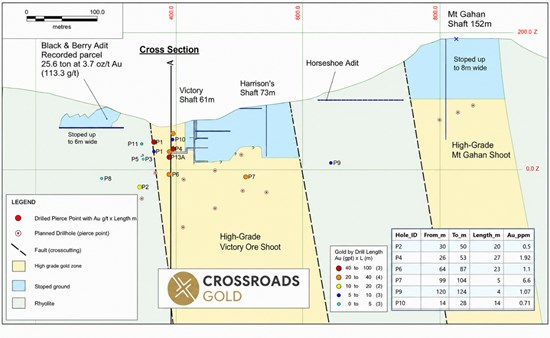
Beyond that, the study describes an east-dipping lode network with brecciated corridors, sulphide-associated mineralization and north-plunging high-grade shoots, with sulphide and arsenopyrite content increasing at depth. It also identifies untested deep structural targets, including a feeder zone originally projected at around 400 metres and now placed by Crossroads at roughly 250 to 300 metres. Historical references to electrum, silver sulphosalts and stibnite hint at silver and antimony potential that has never been systematically assayed.
The reinterpretation builds on field results from earlier this month, when initial soil sampling returned values up to 24.6 g/t gold across 110 samples. The Pambula and Club Terrace assets came to Crossroads through its May acquisition of Rox-ex.
Crossroads plans to fold the dataset into GIS and 3D models to guide structural modelling, geophysics and deeper drilling.
Crossroads Gold last traded at $0.21 on the TSX Venture.