
Germany’s in for a bitter winter. For Europe’s largest economy, it seems that the question isn’t about whether or not it’s headed for a recession, but rather about how long and deep this recession will be.
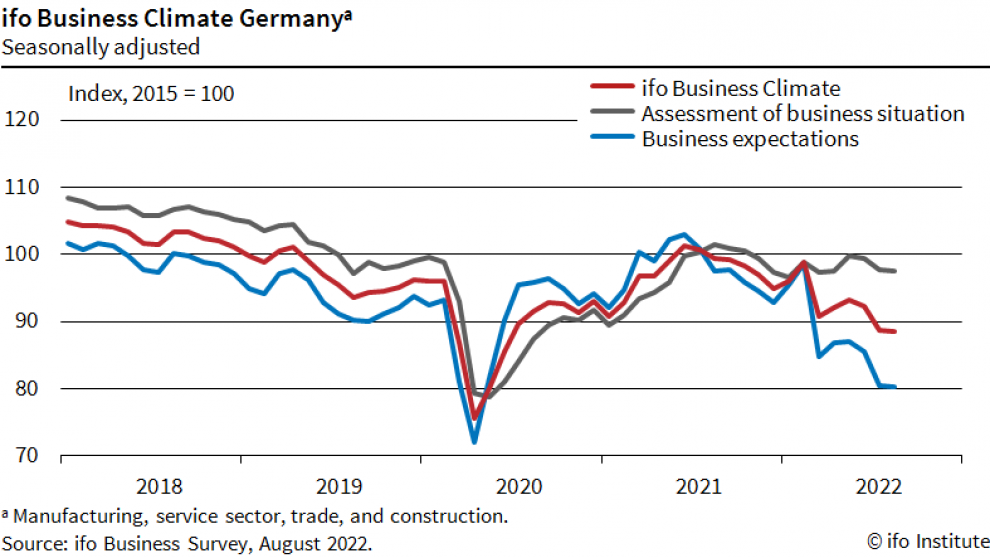
The ifo Index has fallen for a third consecutive month, hitting 88.5 in August, coming from 88.7 in July. This is the lowest the index has seen since the early months of the pandemic in June 2020. The index says that the German economy is expected to shrink in the third quarter.
The country’s GDP grew slightly by 0.1% in the second quarter, and private consumption was up 0.8%. But it’s difficult to see this figure holding up as inflation continues to skyrocket, and energy bills are expected to double or even triple in the coming months as Russia continues to tighten its grip on natural gas.
 Sponsored · Selkirk Copper Mines
A Cold and Expensive Winter
Much of the uncertainty in Germany’s economy comes from soaring energy costs. Bloomberg’s Javier Blas shared wholesale day-ahead electricity prices in Europe on Twitter on Monday. The map showed Germany going up to €658.41 per megawatt-hour. In 2020, the country was paying only €31 per MWh.
The year-ahead contract for electricity, meanwhile, has risen to €995 per MWh, more than 10 times last year’s figures. This, plus Russia’s ongoing war in Ukraine and the global supply chain disruptions, make up the recipe for a likely winter recession.
New Energy-Saving Measures
On Wednesday, the government approved new energy-saving measures. Beginning in September, public buildings, except for hospitals, can only be heated up to 19C (66F), and heating may be completely shut off in entrances, corridors, and foyers.
Lights in public monuments and buildings will not be turned on for aesthetic reasons, and businesses may also be banned from keeping shop lights on overnight. The measures, which will be in place for six months, also include a ban on heating private swimming pools.
The government aims to slash gas usage by 2% with these new measures. The measures, according to the country’s economy minister, could save households, companies, and the public sector around €10.8 billion over two years.
Information for this briefing was found via Bloomberg, Reuters, and the sources and companies mentioned. The author has no securities or affiliations related to this organization. Not a recommendation to buy or sell. Always do additional research and consult a professional before purchasing a security. The author holds no licenses.