

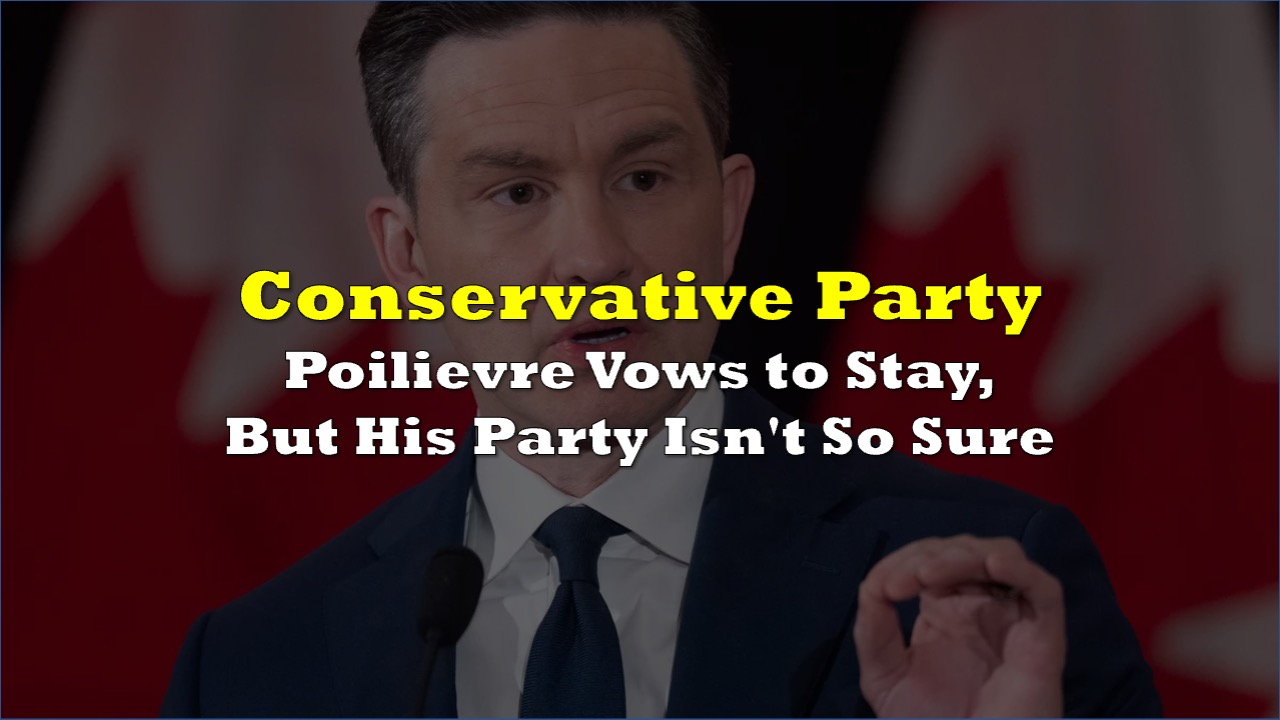

The resignation rumors didn’t materialize — but the conditions that generated them haven’t changed.
“I will continue to lead that fight in this House, across the country and in the next election,” Poilievre told reporters April 14, the morning after Prime Minister Mark Carney’s Liberals swept three byelections and secured a majority government.
Unconfirmed reports had circulated as recently as April 8 that Poilievre planned to step down once Carney crossed the 172-seat majority threshold. Instead, he dismissed the result as “manufactured and costly,” the product of “dirty backroom deals,” and pledged to hold the government accountable. Whether the Conservative caucus gives him that chance is far from settled.
 Sponsored · Selkirk Copper Mines
The numbers don’t lie
Canada’s premier pollster Nik Nanos pegged the preferred prime minister gap at 31 points in Carney’s favor following the byelection results — a deficit that deepened steadily since the Conservatives lost the spring 2025 federal election despite months of polling leads heading into the campaign.
Party insiders suggest Poilievre drags the party’s broader polling numbers down by roughly 15 points, and then it was reported that as many as 40 Conservative MPs fear electoral defeat under his leadership.
Four Conservative floor-crossings sharpened that anxiety — Nova Scotia MP Chris d’Entremont, Toronto MP Michael Ma, Edmonton MP Matt Jeneroux, and most recently Marilyn Gladu, a four-time MP and prominent social conservative whom Poilievre had personally backed in the 2022 leadership race.
Gladu’s departure pushed the Liberals to within one seat of a majority ahead of the April 13 byelections, which Carney’s party swept to finish with 174 seats in the 343-seat House of Commons.
 Sponsored · PTX Metals Inc.
The Reform Act sword
The Reform Act lets a caucus force a secret ballot on its leader if enough members sign a petition — a threshold that for the Conservatives’ 140-member caucus sits at 28 MPs. Sources close to Poilievre told CBC News his team canvassed the caucus after Gladu’s defection and came away confident no such move was imminent.
Poilievre’s response to the pressure has been to frame every challenge to his authority as procedurally illegitimate. “My mandate doesn’t come from dirty backroom deals,” he said April 9 when asked whether the floor-crossings warranted reflection on his leadership.
When reporters asked Carney whether Poilievre should resign, the PM declined: “I can’t look into the heart of Mr. Poilievre. I respect him as a parliamentarian, as I do the other leaders of the parties, and I’ll continue to work with him and all parliamentarians.”
Critics noted the irony in Poilievre’s legitimacy argument — he retained his parliamentary seat after losing his Ontario riding by taking over a vacated Alberta constituency. Party members handed Poilievre an 87% support vote at a recent convention, but membership votes and caucus sentiment are different animals.
Communications director Katy Merrifield resigned April 8 — the same day the floor-crossing rumors peaked — with Micah Green taking over the role and Sam Lilly moving to media relations.
Why the majority may be his best friend
A Liberal majority actually removes the single biggest structural threat to Poilievre’s leadership. Under a minority government, any stumble in the House could have triggered an early election before he was ready. With Carney now holding a majority, Poilievre gains time to rebuild his coalition, sharpen his message, and wait for the government’s honeymoon to erode.
Carney inherits the majority alongside a crowded agenda — US tariffs, housing, defense spending, and the economic fallout from a year of Canada-US trade turbulence. The more the government owns the status quo, the more space Poilievre’s affordability message has to land. The Conservatives grew their seat count in 2025 and posted their highest popular vote share since the party’s modern formation in 2003 — that floor gives him something to build from.
The question he still can’t answer
His caucus has begun voicing a sharper critique: that Poilievre’s brand — combative rhetoric, anti-establishment populism, opposition barnstorming — fits the benches he occupies but doesn’t read as prime ministerial.
The gap showed clearly on April 14, when a clip of Poilievre declaring Carney “very badly educated on economics” went viral — partly for the line itself, partly for a visible water dribble down his chin as he delivered it. When reporters put the comment to Carney, the former Bank of Canada and Bank of England governor — holding economics degrees from Harvard and Oxford — paused and replied: “Did he? Wow.”
Poilievre’s path forward relies on doubling down on a blue-collar economic message and waiting for Carney to own an affordability crisis that hasn’t been resolved. That requires patience, message discipline, and a caucus willing to hold — none of which are guaranteed.
For now, Poilievre leads. The harder question is whether the Conservative Party decides that leading and winning are still the same thing.
Information for this story was found via the sources and companies mentioned. The author has no securities or affiliations related to the organizations discussed. Not a recommendation to buy or sell. Always do additional research and consult a professional before purchasing a security. The author holds no licenses.





One Response
He still has a base that drank the cool aid. They do not understand the effects of world economics. They love the petty quips and are still sore losers over the last election. If he keeps that base and everyone of them still believes in the old tired nostalgia of the Con message….undoubtedly any majority government will look tired with mistakes made and affordability will be a challenge due to things like the big T to the south who starts willy nilly wars and throws unjustified tariffs at us (all pretty much out of our control). He can keep throwing misinformed and exaggerated stats at the populace that the media does not fact check. The average citizen does not do it’s homework, so many will be outraged in our outraged social media society. He will have his base. That is why he sticks around. He also believes he is right. He knows nothing else but politics either….so.