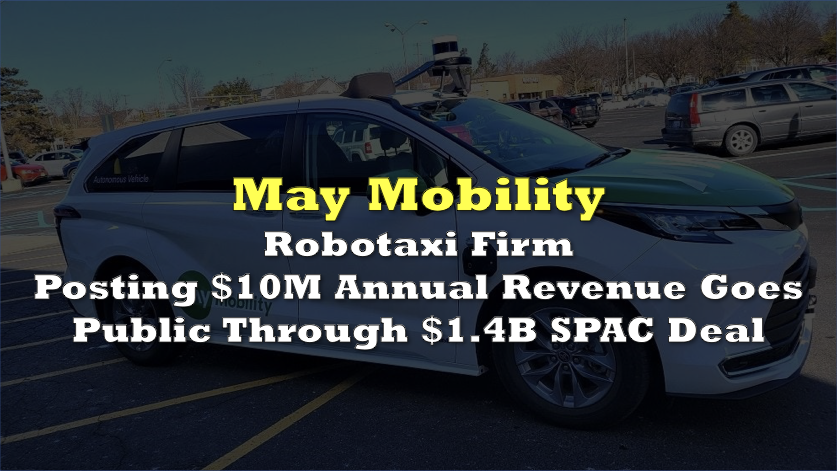

May Mobility is asking public-market investors to back a $1.4 billion enterprise value while the autonomous-driving company is still generating only about $10 million of annual revenue, betting that an asset-light licensing model can close the gap between its current scale and its expansion plans.
The Ann Arbor, Michigan-based company said it agreed to merge with ACP Holdings Acquisition Corp., a special purpose acquisition company affiliated with Atlas Credit Partners. The transaction is expected to provide up to $337 million in gross proceeds and would list the combined company on Nasdaq under the ticker “MAY.”
The financing includes a fully committed $120 million PIPE and as much as $217 million from ACP’s trust account, subject to shareholder redemptions. ACP reported $217.4 million of investments held in trust as of June 30. The companies expect the transaction to close by year-end, subject to shareholder approvals and other closing conditions.
 Sponsored · Selkirk Copper Mines
May disclosed approximately $10 million of revenue in 2025 at a 27% gross margin. Cash burn totaled about $93 million over the same year. The company has raised approximately $445 million since its founding in 2017.
The gap between those financials and the proposed valuation sits at the center of May’s public-market pitch. Rather than owning and operating large robotaxi fleets itself, May is transitioning toward what it calls an Autonomy-as-a-Service model. Fleet partners are expected to carry vehicle ownership, depot, operations, and maintenance costs, while May supplies autonomous-driving technology.
Axios reported that May expects to earn fixed or per-trip licensing fees under the model and is targeting long-term gross margins of as much as 70% and EBIT margins of up to 30%.
Operationally, May says it has completed more than 550,000 commercial autonomous rides across 1.1 million miles in the US and Japan. It currently has commercial operations in Atlanta, Eden Prairie, and Grand Rapids, Minnesota, and is targeting a launch with Uber in Arlington, Texas, in Q4 2026 or Q1 2027.
Its partner network includes Toyota, Uber, Lyft, Grab, NTT, ECARX, and CaoCao. May said fleet operators in its model will assume much of the capital burden associated with scaling deployments.
Proceeds from the SPAC transaction are expected to fund research and development, hardware cost reductions, supply-chain investments, new US and international deployments, and working capital.