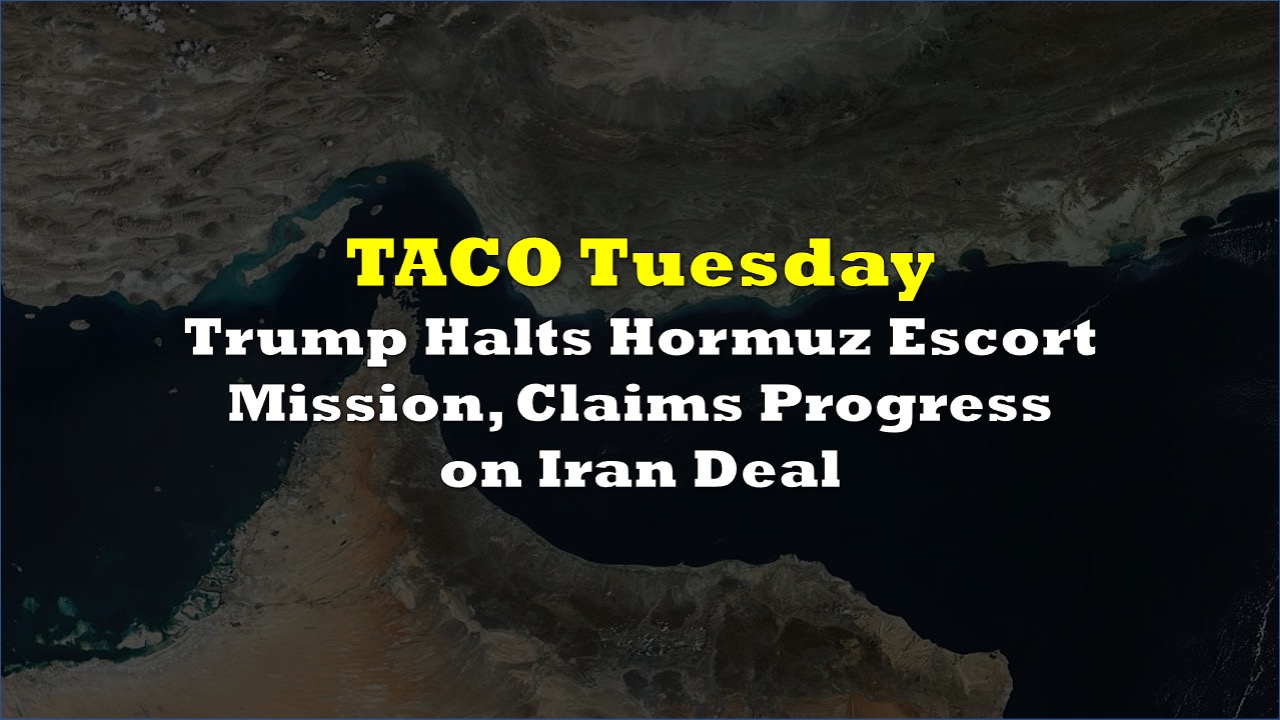

President Donald Trump paused Project Freedom on Tuesday — less than 48 hours after launching the naval escort mission to push commercial vessels through the Strait of Hormuz — citing diplomatic progress toward a final agreement with Iran.
The US blockade of Iranian ports remains in full effect.
Trump announced the decision on Truth Social, saying Pakistan and other countries had requested it and that “great progress” had been made toward a “complete and final agreement” with Iranian representatives. The operation, which began May 4, immediately drew armed resistance: Iran launched ballistic missiles, cruise missiles, and drones at the United Arab Emirates on Monday, and a South Korean-operated vessel caught fire in the strait the same day.
Hours earlier, Secretary of State Marco Rubio told reporters at the White House that Project Freedom existed to “rescue” stranded sailors that Iran had “left for dead” — framing the mission as a matter of life and death for thousands of civilian crew members. Rubio also confirmed that Operation Epic Fury, the broader US-Israeli air campaign launched February 28, has formally ended, with US forces now operating in a defensive posture.
 Sponsored · Altamira Gold Corp.
Read: Breaking: US Tanker Disappears Over Strait of Hormuz as Project Freedom Enters Second Day
“If they pose a threat to our forces, we’ll shoot down drones, we’ll shoot down missiles. But it’s defensive in nature,” Rubio said.
Nearly 23,000 sailors on vessels representing 87 countries remain stranded in the Persian Gulf. The US has not said how or when those crews will be evacuated.
Read: Rubio Says US Wants Hormuz Strait ‘Back To The Way It Was’
State-run news agency INSA attributed the pause to “firm positions and warnings” from Tehran — directly contradicting Trump’s claim of mutual agreement and deal progress.
Violence in the Strait has not stopped. The United Kingdom Maritime Trade Operations centre reported early Wednesday that an unknown projectile struck a cargo vessel in the waterway. No group claimed responsibility.
Oil markets responded to the announcement with modest relief. Prices retreated but remained above $100 a barrel, while average US gas prices edged up to $4.48 a gallon.
Pakistani Prime Minister Shehbaz Sharif — whose government has mediated talks between Washington and Tehran since the ceasefire — welcomed the pause, calling it “absolutely essential” that the truce hold to allow “diplomatic space for dialogue leading to enduring peace.”
Iran’s Foreign Minister Abbas Araghchi traveled to Beijing on Wednesday for face-to-face talks with his Chinese counterpart — the first meeting between the two since the war began. Trump is scheduled to travel to China next week for what analysts describe as the most consequential trip of his second term.
At the United Nations, the US circulated a draft Security Council resolution demanding Iran halt attacks, disclose sea mine locations, and cooperate with clearance efforts. Bahrain, Saudi Arabia, the UAE, Kuwait, and Qatar co-sponsored the text. China and Russia had vetoed a previous US resolution; whether the revised, narrower effort can clear the Council remains an open question.
The Strait of Hormuz carries roughly 20% of the world’s seaborne oil supply. Commercial traffic through the waterway has fallen more than 90% since Operation Epic Fury began in late February.
Information for this story was found via the sources and companies mentioned. The author has no securities or affiliations related to the organizations discussed. Not a recommendation to buy or sell. Always do additional research and consult a professional before purchasing a security. The author holds no licenses.