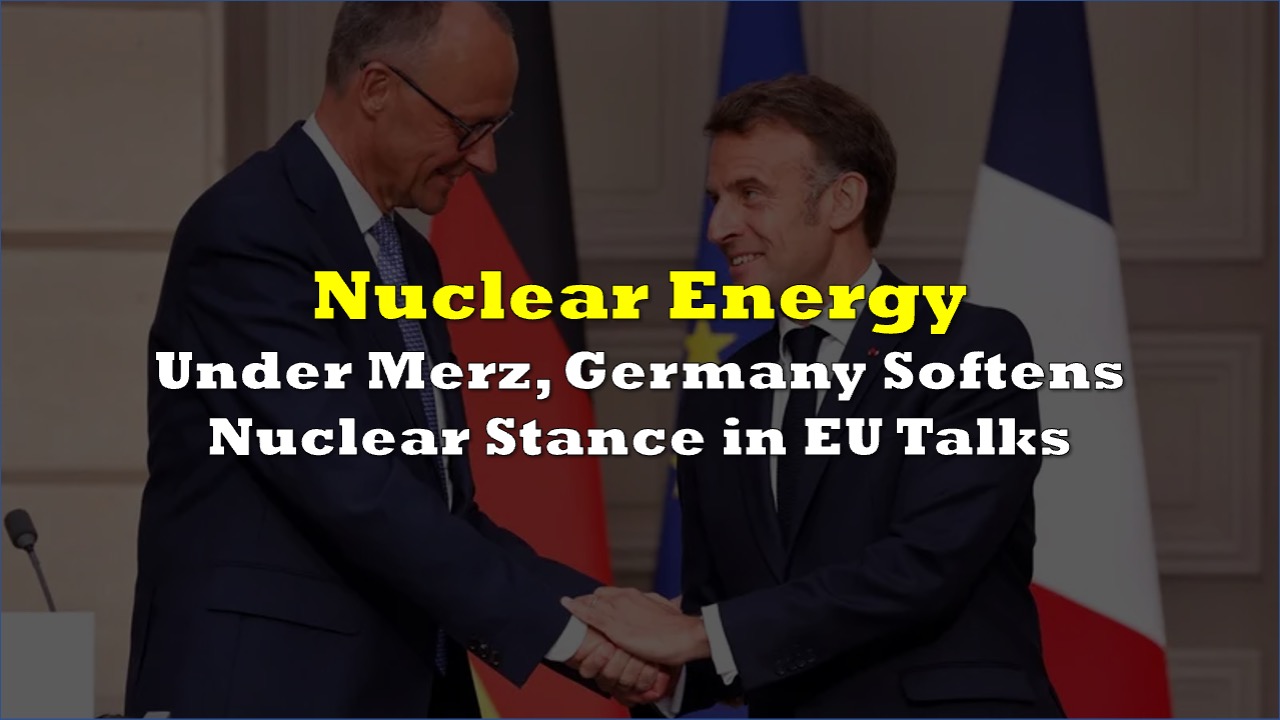

Chancellor Friedrich Merz’s government is easing Germany’s stance against nuclear energy in European Union policy discussions, German and French officials said, potentially breaking a years-long impasse on EU energy legislation.
The new approach enables cooperation with France on regulatory frameworks that would classify nuclear power as a low-carbon energy source similar to renewables in EU sustainable energy taxonomies, addressing what had become a significant source of tension between Europe’s largest economies.
According to reporting in the Financial Times, a German official described the policy change as a “sea-change policy shift,” adding that “all the biases against nuclear power, which still remain here and there in EU legislation, will be removed.”
 Sponsored · Altamira Gold Corp.
Merz, who was sworn in as chancellor in March following his Christian Democratic Union’s victory in February elections, works to repair Franco-German relations that deteriorated under former chancellor Olaf Scholz, particularly during the energy crisis following Russia’s invasion of Ukraine.
Despite this realignment, Germany isn’t reversing its domestic nuclear exit, completed in April 2023 when it shut down its last three nuclear plants. Nuclear plant operators have rejected calls to restart the decommissioned reactors, citing technical and financial obstacles.
Energy analysts describe the policy adjustment as a response to growing concerns about Germany’s energy independence and economic competitiveness. Following its nuclear phase-out, Germany’s reliance on imported energy has increased substantially, with nearly 70% of its energy needs met through imports. For natural gas specifically, import dependency exceeds 95%, according to Bloomberg reporting.
This new stance helps address several unresolved EU energy policy issues, including classification standards for hydrogen production methods and inclusion of nuclear energy in sustainable investment frameworks. These matters have deadlocked EU decision-making since Russia’s invasion of Ukraine heightened energy security concerns across the continent.
 Sponsored · Cambria Gold Mines
French President Emmanuel Macron acknowledged the shift during Merz’s visit to Paris earlier this month. “To ensure our energy sovereignty while respecting national choices, we are calling for an end to all discrimination at European level against low-carbon energies, whether nuclear or renewable,” Macron said.
Germany’s nuclear exit has been controversial domestically. Earlier this year, nuclear industry representatives claimed up to six shuttered plants could theoretically restart. But major utility companies, including E.ON and RWE, have dismissed these suggestions as economically and technically unfeasible.
Instead, Merz has pledged to build 50 new gas-fired power plants while investing in nuclear research, particularly small modular reactors and fusion technology, which his government sees as potential future energy solutions.
There has been a broader reconsideration of nuclear energy in Europe of late amid security concerns. Denmark is reviewing its 40-year ban on nuclear power, while Italy’s government has proposed returning to nuclear energy after abandoning it following the 1986 Chernobyl disaster.
Information for this story was found via the Financial Times, Bloomberg, and the sources and companies mentioned. The author has no securities or affiliations related to the organizations discussed. Not a recommendation to buy or sell. Always do additional research and consult a professional before purchasing a security. The author holds no licenses.