
Kentucky’s 4th District did not need $32 million to decide whether it would stay Republican, but it did need that much to decide what kind of Republican could survive there.
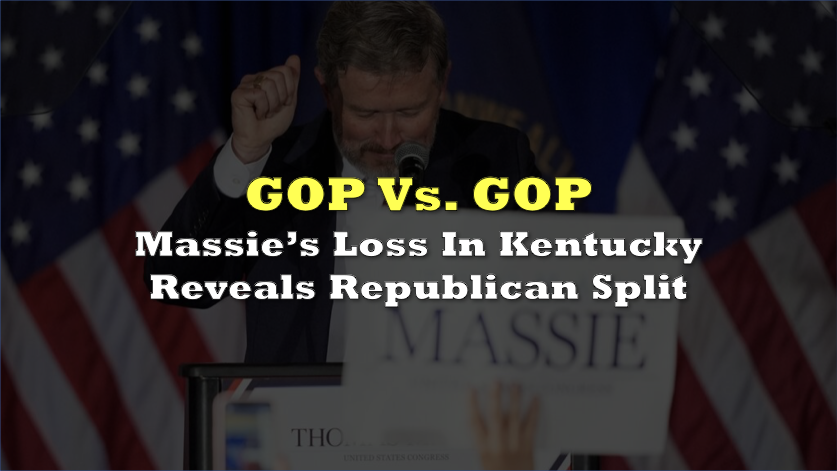
Incumbent Rep. Thomas Massie’s defeat by Ed Gallrein turned a safe red-seat primary into a party-on-party enforcement fight, with one Republican coalition arguing for obedience to the Trump-era governing machine and another defending an older insurgent brand built around spending restraint, war skepticism, and suspicion of institutional secrecy.
Gallrein, a Trump-backed retired Navy SEAL and farmer, defeated Massie 54.9% to 45.1% with 99% of votes counted, according to Reuters.
 Sponsored · Selkirk Copper Mines
The margin mattered less than the machinery. Reuters reported that the race drew $32 million in ad spending, citing AdImpact, making the Kentucky race one of the clearest 2026 examples of a Republican primary being treated like the main election because, functionally, it was.
Reuters also reported more than $15 million in spending from the Republican Jewish Coalition, AIPAC, and a Trump-aligned super PAC funded by pro-Israel donors.
This was not a classic swing-seat contest where both parties fought over persuadable voters. It was a fight inside the same party over which faction gets to call itself the real GOP.
Massie made that conflict unusually hard to contain. He was not running as a moderate Republican. He was running as a Republican who often attacked the party from its right flank or libertarian edge, turning the usual primary script into a glitch in the matrix.
 Sponsored · Altamira Gold Corp.
On fiscal policy, Massie resisted Trump-backed spending and tax priorities. On foreign policy, he criticized US military action in Iran and challenged aid to Israel. On institutional transparency, he helped drive a House discharge petition connected to the release of Jeffrey Epstein-related Justice Department records. Reuters identified those disputes as part of the conflict that drew Trump’s attention and outside spending into the race.
That mix made the primary combustible because none of the issues sat neatly in a left-right box. Massie’s positions appealed to parts of the populist right that distrust foreign entanglements, donor influence, and government secrecy. At the same time, they put him against a Trump-aligned party apparatus that increasingly treats internal dissent as a governability problem.
Former Rep. Marjorie Taylor Greene’s reaction made the GOP-vs.-GOP fracture explicit. In her post, Greene praised Massie and claimed, “Releasing the Epstein files was our demise.” She also argued that “the future of the Republican Party was destroyed” and predicted that a younger “Real America First Movement” would rise against the party’s old guard.
Compared to Massie, Gallrein’s offer to voters was simpler. He ran as the lower-friction Republican option, aligned with Trump and positioned to support the party’s current command structure.
For Republicans, the lesson is colder than “Trump beats critics.” It is that internal dissent now has an invoice.
A Republican incumbent can vote with the party most of the time and still become vulnerable if the exceptions touch the issues that matter most to the party’s power centers. The punishment does not require a competitive general election. It requires a safe seat, a challenger with acceptable credentials, a presidential signal, and enough outside spending to make the primary feel national.
That is why Massie’s loss does not end the GOP civil war. It clarifies the battlefield.
The fight is no longer only conservatives against moderates, or establishment Republicans against MAGA. It is Republicans against Republicans over who controls the meaning of “America First” when fiscal restraint, military restraint, Israel policy, Epstein transparency, and Trump loyalty point in different directions.
Information for this briefing was found via the sources and the companies mentioned. The author has no securities or affiliations related to this organization. Not a recommendation to buy or sell. Always do additional research and consult a professional before purchasing a security. The author holds no licenses.