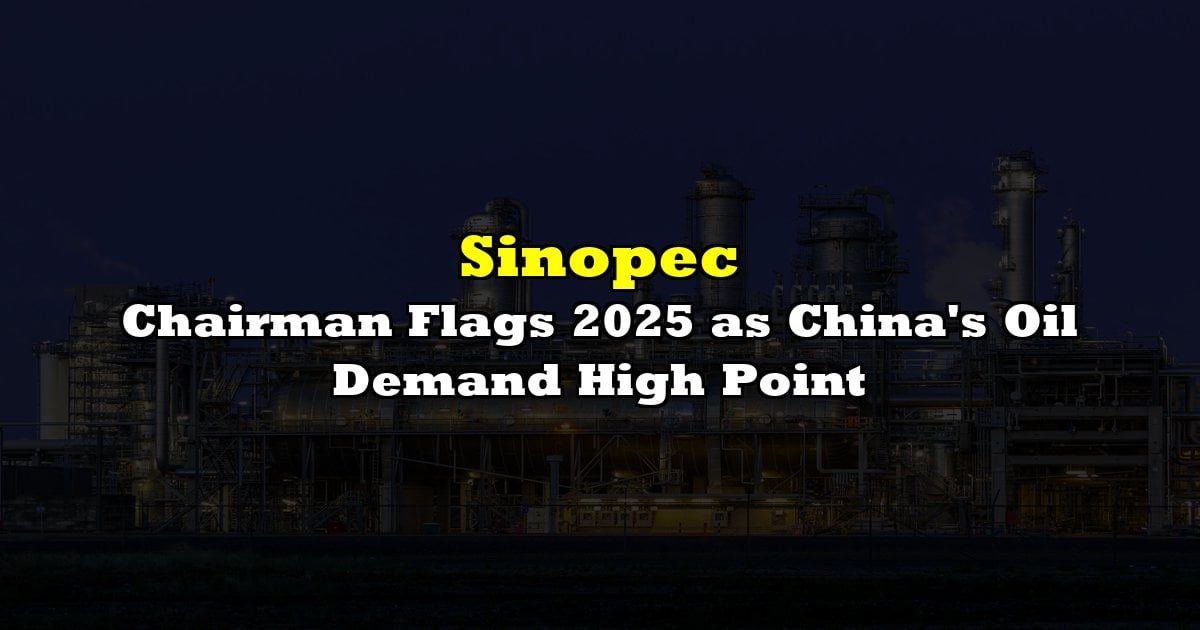

The moment analysts spent years bracing for may already be in the rear-view mirror. China’s oil consumption likely crested in 2025, the boss of the country’s biggest refiner has suggested, a turning point that lands earlier than nearly anyone expected.
Speaking at an earnings briefing in Hong Kong on Monday, Sinopec Chairman Hou Qijun pointed to the spread of clean energy, electrification and low-carbon targets as the forces that have probably carried national demand beyond its high point. That timeline undercuts the company’s own prior estimate of 2027, and it runs ahead of Beijing’s goal of capping oil and coal use somewhere inside the current five-year plan, which extends to 2030.
“Next year, even if the US-Iran conflict eases up, things might recover, but it won’t hit last year’s level,” Hou said. “So it’s very likely demand peaked last year.”
 Sponsored · Selkirk Copper Mines
The stakes are considerable given China’s status as the planet’s largest oil importer. A demand rollover that begins sooner than forecast would ease the country’s world-leading emissions while unsettling the calculations of the biggest crude producers.
In its earnings report, Sinopec, formally China Petroleum & Chemical Corp., flagged a first-half slide in road fuel use as higher prices and a shift toward electric vehicles kept drivers away. Senior vice president Tian Hongbin expects that drop to moderate over the back half of the year as supportive economic policies take hold. First-half profit climbed 19.3%.
Sinopec now sees its own throughput sliding to 226 million tons this year, equal to 4.55 million barrels per day, the lowest since 2012.
President Wan Tao said domestic supply is being covered even as demand cools, with crude sourcing moving away from the Middle East. Eleven tankers once stranded in the Persian Gulf, holding 2.76 million tons of crude between them, have since arrived. Sinopec generally keeps roughly 20 days of crude for refining and 15 days of products for marketing, Wan added, with stocks holding firm through the war.