

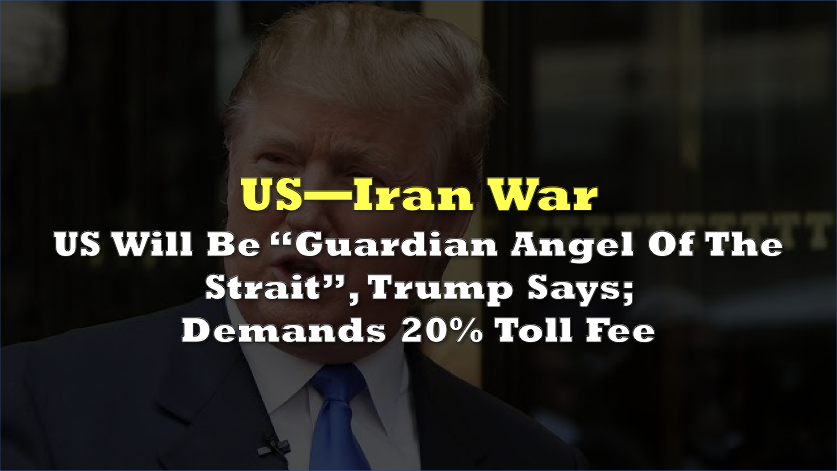

President Donald Trump said Monday that the US will assume responsibility for securing the Strait of Hormuz and seek payment from countries that benefit from the waterway, proposing what would be a major shift in how Washington approaches one of the world’s most strategically important shipping lanes.
In a Fox News interview cited by CBS News, Trump said the US would continue protecting the strait but would no longer do so without compensation.
“We’re going to keep the strait, and we’ll probably run it. We’ll become the guardian of the strait. Maybe we’ll call it the ‘Guardian Angel of the Strait.’ And we should be reimbursed for that,” Trump said.
He said countries benefiting from safe passage through the Persian Gulf should bear part of the cost.
 Sponsored · Selkirk Copper Mines
“When we do that, we’re going to be reimbursed, because the other nations are very wealthy, they’re on our side, and we can’t be expected to do that for nothing,” Trump said.
Trump added that the US had protected the waterway for decades without receiving compensation.
“We guarded it for 50 years, more, and we never got paid for it,” he said. “We guarded it for nothing, and now we’re going to guard it. We’re going to get paid for guarding it, a lot of money.”
Trump expanded on the proposal in a Truth Social post, declaring that the “Hormuz Strait is OPEN, and will remain OPEN with or without Iran.”
He announced that the US would become “THE GUARDIAN OF THE HORMUZ STRAIT” and said it would be reimbursed “at the rate of 20% on all cargo shipped” to cover “any and all costs necessary to do the job of providing safety and security.” Trump added that “the process and formation will begin immediately.”
The remarks come as the Strait of Hormuz remains at the center of tensions between Washington and Tehran. Before the US and Israel launched military operations against Iran on Feb. 28, commercial shipping moved freely through the narrow waterway, Reuters reports. Since then, maritime traffic has fallen sharply as security concerns have intensified.
A dispute over control of the strait has also complicated negotiations aimed at securing a lasting peace agreement.
Iran maintains that a memorandum of understanding signed with the US in mid-June gives Tehran authority over shipping through the strait. The US rejects that interpretation and has encouraged commercial vessels to use the southern shipping lane near Oman, which Trump has repeatedly described as remaining open.
CBS further reported that Iran’s embassy in the UK accused Washington on Monday of violating the agreement “since day one” by directing ships toward what it described as a “dangerous southern parallel route” near Oman’s coastline. The embassy said the route is “legally questionable” and poses safety risks.
The dispute has escalated in recent days. Iran attacked several vessels using the southern route last week and struck a container ship near the western entrance to the Strait of Hormuz on Saturday. The attacks prompted multiple rounds of US airstrikes against Iranian targets.
Later Monday, Iran’s Persian Gulf Strait Authority said on social media that “due to recent hostile actions by the US forces, passage through the Strait of Hormuz is currently unfeasible.”
The authority said permit applications would resume only after stability returned and reiterated that vessels seeking passage must obtain authorization through its official permitting system.
In the latest move, Trump said that Iran had asked the US to continue talks and that Washington had accepted. However, he also said the US had informed Tehran “in no uncertain terms” that the ceasefire was over.
Trump’s proposal to charge countries for US protection follows weeks of criticism from Washington over Iranian suggestions that commercial vessels could eventually face transit fees to use the strait. His latest proposal would instead place the cost of securing the waterway on countries that rely on it for trade and energy shipments, though no formal US policy establishing such payments has been announced.



One Response
Countries hurt by the Strait closing should sue the U.S. for damages. The absolute incometency of the administration has led to this. Now the orange tyrant will try to find a way to enrich himself out of the chaos he has created.