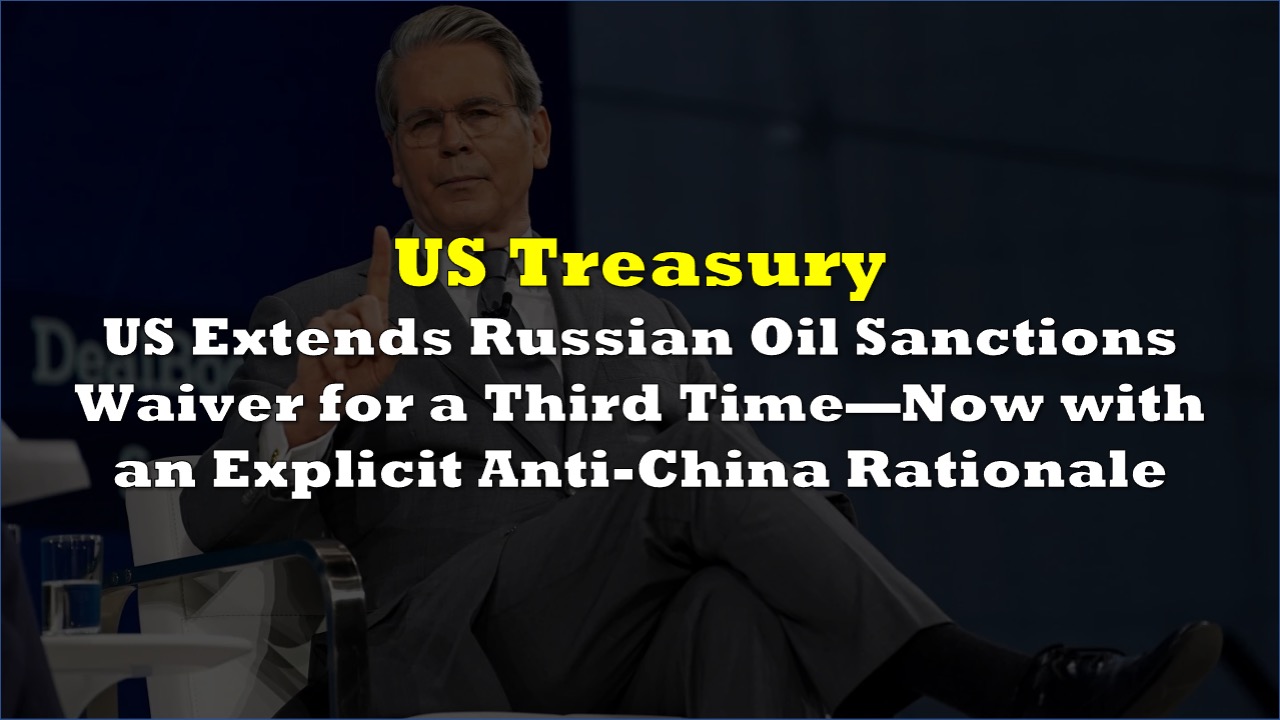

The US Treasury has issued a third 30-day extension of its Russian oil sanctions waiver, this time with a new explicit justification: redirecting discounted Russian crude away from Chinese stockpiles and toward energy-vulnerable developing nations.
Treasury Secretary Scott Bessent announced the extension on May 18, two days after the previous waiver lapsed — reversing a position the administration had signalled it would not renew. OFAC issued General License 134C, replacing GL 134B. The new license covers Russian crude and petroleum products loaded on vessels on or before April 17, 2026, authorizing their delivery and sale through June 17 without breaching US sanctions on Rosneft and Lukoil — the two Russian oil majors designated by OFAC in October 2025. It does not authorize purchases of Russian oil loaded after that date.
The original license, issued March 12, was framed as an emergency measure to stabilize oil markets after the Strait of Hormuz closure drove prices above $100 a barrel. It expired on April 11. A second extension expired May 16. Bessent said the first waiver had helped put “more than 250 million barrels on the water.” US gasoline prices remain elevated and have not materially declined.
Previous waivers were justified on supply stabilization and humanitarian grounds. This extension adds a third rationale: “It will also help reroute existing supply to countries most in need by reducing China’s ability to stockpile discounted oil,” Bessent wrote on X.
 Sponsored · Altamira Gold Corp.
The announcement came three days after Trump concluded two days of meetings with Xi Jinping in Beijing, a summit Trump described as producing “fantastic trade deals” but which analysts described as heavy on ceremony and light on specifics, with no agreement on the Iran war or the Hormuz closure. Bessent was also in Beijing for the summit before traveling to the G7 finance leaders’ meeting in Paris, where he called for stricter global enforcement of Iran sanctions, arguing the regime’s oil revenues were “fueling the Iranian war machine.”
India is the other major beneficiary. As one of the largest buyers of discounted Russian crude since 2022, India has relied on continued access to Rosneft and Lukoil cargoes during the Hormuz crisis, with Gulf alternatives scarcer and more expensive since March.
In March, Prime Ministers Carney, Merz, and Støre publicly rejected the first waiver at a joint press conference at NATO’s Cold Response exercise. Merz said six of the seven G7 nations opposed the decision. Carney was blunt, saying “Canada’s position is to maintain sanctions on Russia, including on the shadow fleet which is moving this oil.” No allied government has publicly reversed that position.
Democratic Senators Jeanne Shaheen and Elizabeth Warren called the extension an “indefensible gift” to Putin. “Every additional dollar the Kremlin earns from this license helps Putin finance his illegal war against Ukraine and kill innocent Ukrainians,” they said, adding that the waivers have not driven down US gasoline prices or stabilized global energy markets.
Each extension also extends the period during which Russia earns elevated revenues from oil exports it would otherwise struggle to move.
Read: IMF: Russia Wins, Europe Bleeds, Iran Collapses—The War’s Economic Scorecard
If the Hormuz crisis remains unresolved and oil prices stay elevated, a fourth extension is the likely outcome. If a ceasefire is reached or the Strait reopens, the administration would face pressure to enforce the underlying sanctions — a test of whether the waiver was always temporary or has become a de facto permanent concession to Moscow.
Information for this story was found via the sources and companies mentioned. The author has no securities or affiliations related to the organizations discussed. Not a recommendation to buy or sell. Always do additional research and consult a professional before purchasing a security. The author holds no licenses.