
This week there was a story that barely made the headlines in Canada. But it’s a big deal.
BRP Inc. (TSX: DOO) makes Ski-Doos. Sea-Doos. Can-Am off-road vehicles. Big, loud, fun machines. Headquartered in Valcourt, Quebec. 17,000 employees. $8.4 billion in annual sales. One of the few manufacturing names we can still point to with any real pride.
On April 14th, 2026, they got absolutely hammered.
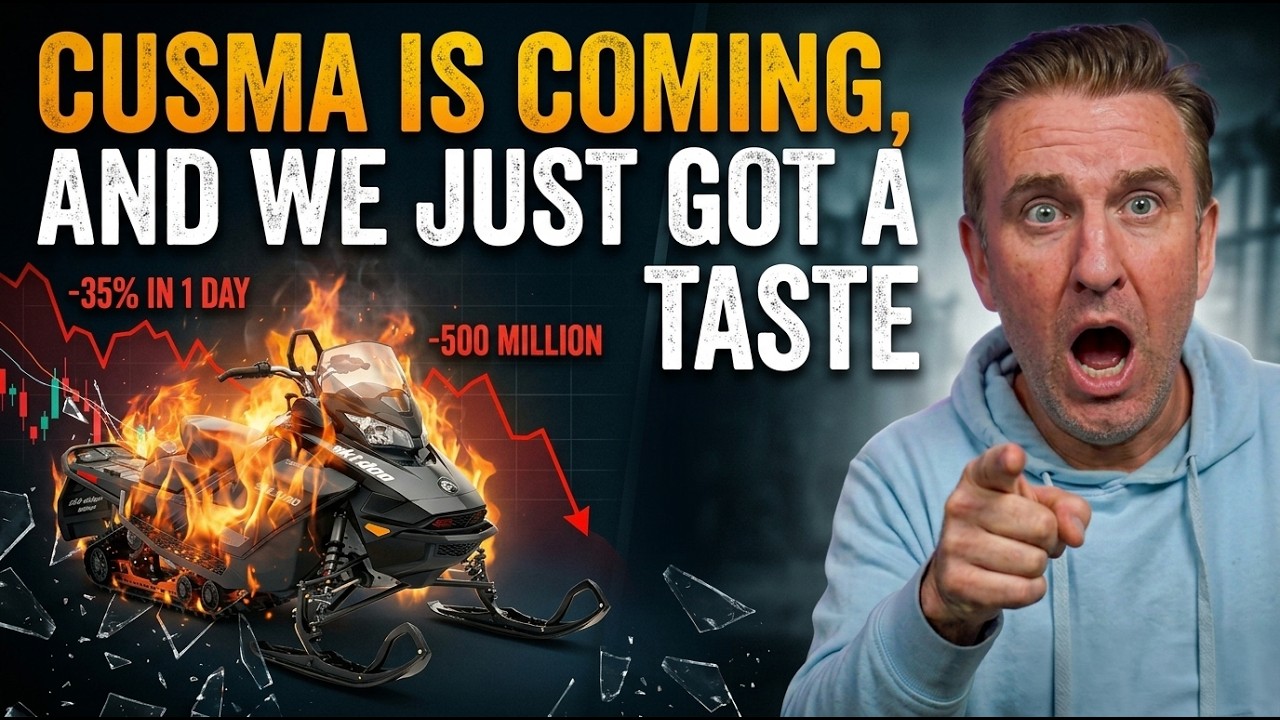
The stock dropped 30% in a single day. At one point it was down 35% in an afternoon. Roughly half a billion dollars in market cap — gone.
The cause? One sentence in one American tariff rule.
The Tweak That Wasn’t a Tweak
A week earlier, on April 2nd, the White House announced what sounded like a boring little adjustment to Section 232. Steel, aluminum, copper.
The old rule: import a product into the US, pay 50% — but only on the metal content of that product. Snowmobile with $2,000 of aluminum in it? You paid 50% on that two grand. Annoying, but manageable.
The new rule: if your product is “substantially made” of steel, aluminum, or copper, you pay 25% on the entire value of the product. The whole thing. Motor, seat, windshield, plastic, the little logo on the side.
Sounds smaller, right? 25% versus 50%.
It’s catastrophically bigger.
A snowmobile isn’t just metal. It’s a $15,000 machine. And now you’re paying 25% on the whole $15,000 instead of 50% on the metal bits.
BRP’s own numbers tell the story. Three weeks ago, they guided investors to roughly $90 million of tariff cost for the year. After April 6th? They’re now estimating over $500 million for the remainder of the year.
That’s not a cost increase. That’s a category-five financial hurricane.
New CEO Denis Le Vot — two and a half months on the job, walked in projecting up to $480 million in net income — just suspended guidance entirely.

Why BRP Specifically?
Fair question. If the rule change is this devastating, why didn’t every Canadian manufacturer blow up on the same day?
Because BRP checks three boxes that very few companies check all at once:
- Heavy metal content. Snowmobiles, side-by-sides, and Sea-Doos are basically rolling chunks of aluminum and steel with a seat bolted on. They clear the “substantially made of metal” threshold easily. A lot of manufactured goods don’t.
- Built outside the US. Roughly 70% of BRP’s production happens in Mexico. The rest is in Quebec. Almost nothing is made on American soil. When the tariff hits at the border, there’s nowhere to hide.
- American buyers. Around 60% of revenue comes from US customers. They can’t just pivot and ship to Europe.
Compare that to their archrival Polaris (NYSE: PII). Polaris makes snowmobiles too, but builds them in Minnesota. No border. No tariff. Polaris still dropped 11% on the news — they do have some Mexican production — but they didn’t get obliterated.
The tariff didn’t hit “Canadian manufacturing” uniformly. It hit a specific combination: heavy metal, built outside the US, sold primarily to the US.
BRP just happens to check every box. Perfectly. They’re the canary in the coal mine.
Now Look at the Calendar
Here’s why this should keep you up at night.
The BRP disaster happened with CUSMA still technically in place. It happened with Canada still holding its “special relationship” exemption. It happened under the allegedly good version of the trade deal.
And it cost one company half a billion dollars.
Now look at July.
The CUSMA Review
CUSMA — the Canada-United States-Mexico Agreement, formerly NAFTA, renegotiated in Trump’s first term — has a clause called Article 34.7. It says the three countries have to sit down on July 1, 2026, and decide whether to renew it.
Renew it, and we roll for another 16 years.The kind of environment businesses actually need to invest, hire, and build factories.
Don’t renew? That’s where the mechanics get ugly.
If any of the three countries — and let’s be honest about which one — objects to renewal, the agreement doesn’t die. It enters a zombie state for ten years, all the way to 2036. Ten years of annual reviews. Every year, a fresh negotiation. A fresh threat. A fresh chance for the US to walk up to the table and say: give us what we want, or we walk.
And here’s the dangerous part. Even during that ten-year zombie walk, the US can cancel the whole thing with six months’ notice. Article 34.6. Half a year between a presidential tweet and the total collapse of North American free trade.
Think about what that means if you’re running a business. If you’re a CEO deciding whether to build a plant in Ontario or Ohio. If you’re a bank deciding whether to lend to a manufacturer. If you’re a worker wondering if your job exists next Christmas.
You can’t plan. You can’t invest. You can’t commit. Every year becomes a coin flip.
The uncertainty is the weapon. You don’t even need to pull the trigger. Just pointing the gun is enough to freeze an economy.
The Real Exposure
Now imagine July goes badly. Imagine the US sits down and says: we want concessions on dairy. On digital services. On auto rules of origin. On banking. On softwood lumber. On drug pricing. On cultural protections.
And if we don’t get them? We pull our renewal.
Projections suggest Canada-US bilateral trade could contract by 20 to 30 percent.
Seventy-five percent of Canadian exports go to one customer. Our manufacturing sector — steel mills, auto plants, aerospace companies, snowmobile makers — is built on the assumption that a widget made in Windsor can cross into Detroit tariff-free. Kill that assumption and you kill the business model.
Canada’s former chief trade negotiator, Steve Verheul, recently admitted that our trade diversification has been in natural resources — oil, gas, potash, the stuff you dig out of the ground. Manufacturing, he called “the soft spot for us.”
BRP just showed us what that soft spot looks like when you press on it.
And remember — BRP is one of the strong ones. Solid balance sheet. $430 million in cash. Multiple product lines. Global distribution.
If BRP is bleeding, what happens to the auto parts supplier in Oshawa with 200 employees? The machine shop in Cambridge? The steel fabricator in Hamilton?
They don’t get to “suspend guidance.” They get to close.
The Bottom Line
BRP was one company, one product line, one tariff rule. And it shaved 35% off the stock in an afternoon.
CUSMA is all of it. Every sector. Every province. Every job that touches a border.
If the July review goes sideways, the CUSMA exemption that’s currently protecting most other Canadian manufacturers vanishes. And every Canadian exporter becomes BRP. Every single one.
One little anecdote cost BRP half a billion dollars.
July could cost Canada the economy.
Don’t sleep on it.
Information for this story was found via the sources and companies mentioned. The author has no securities or affiliations related to the organizations discussed. Not a recommendation to buy or sell. Always do additional research and consult a professional before purchasing a security. The author holds no licenses.