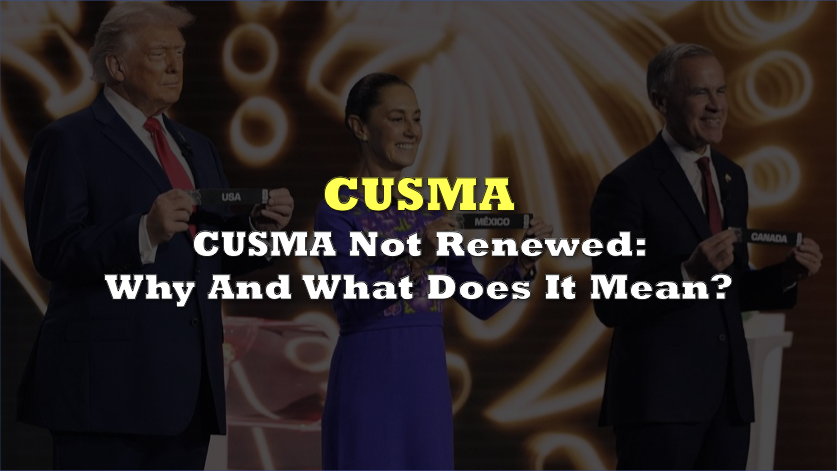

The US has refused to renew its trade deal with Canada and Mexico in its current form. While that means the North America’s central trade agreement will remain alive but politically unsettled, it sets for a deeper geopolitical tension.
US Trade Representative Jamieson Greer said the US, Mexico, and Canada met virtually on July 1 for the first required joint CUSMA review. USTR said the US did not agree to renew.
“The United States will continue to engage with Mexico and Canada to address the Agreement’s shortcomings and our trade deficits with these countries. However, the Agreement remains in force pending resolution of these issues or until the Agreement’s termination,” Greer said in a statement.
 Sponsored · Selkirk Copper Mines
Greer’s caveat is the crucial line for investors, exporters, and manufacturers: the agreement remains in force while the three countries try to resolve the issues, unless the agreement is eventually terminated.
In practical terms, the tariff benefits and legal framework of CUSMA continue for now. The certainty premium does not.
The review becomes the leverage
CUSMA was built with a mandatory six-year review on July 1, 2026. If all three countries agreed to extend it, the pact would have received a fresh 16-year runway.
Since the US did not agree, the deal now moves into a more fragile phase of annual reviews, with the agreement still scheduled to terminate in 2036 unless the parties later agree to extend it.
 Sponsored · Altamira Gold Corp.
That design avoids a sudden cliff but creates a long negotiating fog. The risk is that every year becomes a new checkpoint for rules of origin, tariffs, labor standards, market access, and China-linked supply-chain restrictions.
The White House now gets leverage without immediately taking the political and market hit of withdrawal. Canada and Mexico keep access to the agreement, but only under a clock that Washington can keep winding tighter.
Greer framed the non-renewal around the agreement’s shortcomings and US trade deficits with Canada and Mexico. US concerns include a $197 billion goods trade deficit with Mexico and a $48.3 billion deficit with Canada in 2025.
Washington is also seeking changes tied to manufacturing jobs, auto content, and preventing non-members, particularly China, from benefiting indirectly from the pact.
That marks a sharp turn for a deal President Donald Trump once championed as a replacement for NAFTA. CUSMA is no longer being treated by Washington as the fixed answer to North American trade. It is being treated as a draft that failed to deliver enough US-specific industrial gain.
Autos are the hardest fight
The biggest commercial flashpoint is autos. The Trump administration has reportedly demanded that vehicles contain 50% US-specific content to qualify for preferential treatment. That would sit on top of the existing regional-content system and could push the effective requirement much higher for companies that rely on Canadian and Mexican parts.
AP reported that analysts see the proposed US-specific auto threshold as a major obstacle for Canada and Mexico. Marcos Carias of Coface estimated that only 1 in 5 Mexican and Canadian cars imported into the US would currently meet that standard, with some affected models potentially seeing price increases of 5% to 7%.
That is the strategic tension inside the review. CUSMA was designed to make North America more integrated. The US now wants to make the integration more American.
For automakers, that is not a small paperwork change. North American vehicle production depends on components crossing borders multiple times before final assembly. A US-specific content rule would force companies to rethink supplier maps, plant economics, and model-level pricing.
Canada on the back foot
Greer also confirmed that the US will meet Mexico during the week of July 20 for a third round of bilateral negotiations related to the joint review.
While the review is formally trilateral, the bargaining is increasingly country-specific.
USTR said in June that US-Mexico talks had focused on ensuring the agreement benefits both economies and that its benefits accrue primarily to the parties. The two sides also agreed to support a committee reviewing Chapter 12 sectoral annexes, which cover regulatory compatibility.
Reuters reported that US and Mexican officials broadly agree on several concerns, including declining US manufacturing jobs, Asian parts entering North American auto supply chains, and transshipment risks.
Canada is exposed to a different danger. If Washington and Mexico first settle the auto, industrial, and China-related pieces, Ottawa could face a framework shaped before it has comparable leverage at the table.
Tariff war and trade power
The non-renewal lands after tariffs had already reduced the value of CUSMA’s promise. The Trump administration has imposed 25% tariffs on autos and auto parts from Canada and Mexico, 50% tariffs on steel and aluminum, and 10% tariffs on lumber.
Canada has retaliated, but it has also narrowed the fight. Ottawa removed most counter-tariffs on CUSMA-compliant US imports while keeping duties on steel, aluminum, and autos, a shift that supposedly gives Prime Minister Mark Carney room to negotiate without fully disarming on the sectors still hit by US tariffs.
For agriculture, manufacturing, autos, steel, lumber, and energy-linked trade, the agreement remains the platform. The US has now made clear that the platform is conditional.
On the other hand, Mexico has publicly favored renewal. Reuters reported that President Claudia Sheinbaum said she wanted the free trade zone extended for another 16 years, while Economy Minister Marcelo Ebrard has said he does not expect the trilateral pact to be scrapped.
Canada has signaled openness to improvements, but not a finished agreement at the July 1 review. Reuters reported that Carney expected a constructive exchange but did not expect a deal ready for signature.
The US position is now clearer: no renewal without changes.
The old bargain prioritized regional integration. The new US demand is narrower: more US production, less deficit pressure, fewer Chinese backdoors, and tighter industrial rules.