

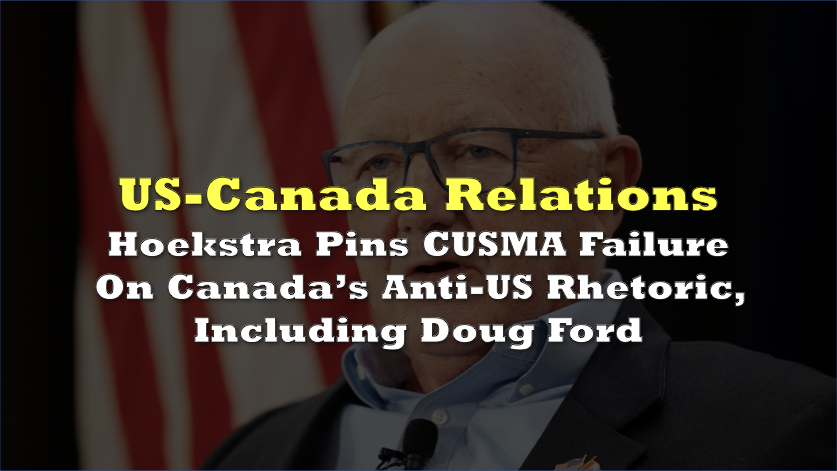

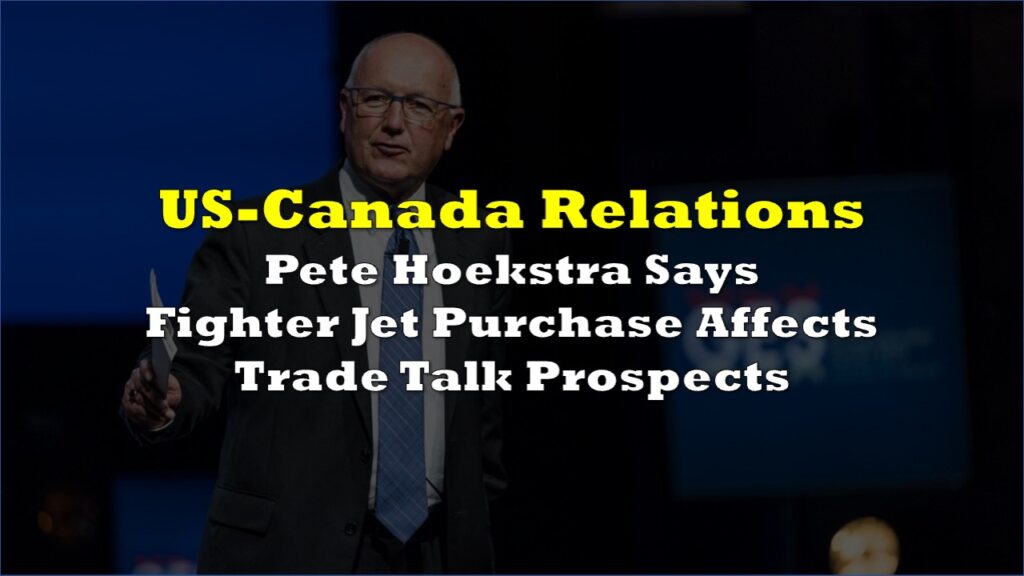
US Ambassador to Canada Pete Hoekstra argued in a new episode of The Food Professor Podcast that US and Canada were close to a broader deal last fall before talks stalled. While he did not mention Ontario Premier Doug Ford by name, host Dr. Sylvain Charlebois posted on X framed Hoekstra’s argument as a claim that Ford’s anti-American rhetoric last fall “contributed to the breakdown in Canada-US negotiations.”
In the podcast, Hoekstra discussed CUSMA’s future, dairy supply management, Canada’s restrictions on US alcohol, the Gordie Howe International Bridge delay, and Trump’s “51st State” rhetoric.
Hoekstra’s own words were narrower but still pointed.
 Sponsored · Granada Gold Mine Inc.
“We were talking about a specific agreement that we came very, very close to fruition in terms of getting it completed in the October, November time frame,” he said. “That would have included steel, aluminum, auto parts, oil, and uranium. That would have been a pretty sizable deal… But that deal was not finalized and so we haven’t necessarily made that much progress since that point.”
In October 2025, Ford’s Ontario government ran a $75 million US ad campaign using Ronald Reagan’s remarks to attack tariffs. Trump denounced the ad and announced that trade negotiations with Canada were terminated. Ford later said Ontario would pause the campaign so talks could move forward.
Hoekstra’s comments now connect that political rupture to the larger CUSMA failure. On July 1, the US declined to renew the trade pact in its current form, sending the agreement into a more uncertain review period rather than giving businesses the clean 16-year extension Canada wanted.
The non-renewal starts a cycle of annual reviews that can continue until the agreement’s possible expiration in 2036 if the three countries do not agree to extend it.
 Sponsored · PTX Metals Inc.
Hoekstra said Washington had expected more progress by now.
“Obviously, from our perspective, we’re not where we want to be,” he said. “We thought we’d be very, very close to having a revised CUSMA and a path forward.”
The ambassador also suggested that Canada is behind Mexico in talks with Washington. He said the US has had “very detailed discussions” with Mexico and is “probably getting fairly close to ironing out a lot of the issues” there.
But, Hoekstra’s argument does not mean Ford alone caused CUSMA’s failure. The US objection list is broader and older than Ontario’s Reagan ad. In the podcast, Hoekstra said Washington wants action on supply management, artificial intelligence, digital and online streaming taxes, pharmaceuticals and other files.
“There’s a litany of things,” he said. On supply management, he added, “Of course, that’s one of the areas that the president has talked about.”
That places dairy and agriculture back at the center of a dispute Canada has tried to manage for decades. The US has long challenged Canada’s supply-managed dairy system, while Canadian governments have treated it as politically sensitive and economically entrenched.
Hoekstra also pressed Canada over provincial restrictions on US alcohol, saying the US buys 93% of Canadian spirits exports while “11 out of 13 Canadian provinces ban the importation and the sale of American spirits.”
“Now that kind of, that’s kind of backwards to me,” he said. “We buy 93% of your exports and you ban ours.”
Hoekstra said the bans affect companies, but also the “psychology” of the relationship.
“We don’t ban any Canadian products,” he said. “Not that I’m aware of, but why is it that Canada has decided that they’re going to ban American products?”
Hoekstra repeatedly emphasized that the US still sees Canada as a valuable trading partner. He said about $2.4 billion in trade crosses the border daily and argued that the public debate is too focused on irritants.
“We’re not mad at Canada,” he said. “We’re fine with Canada. We like Canada. We like doing business with Canada. We don’t ban products and we don’t pick up something and look at it and say, ‘Oh, made in Canada. Put that away.’ Which we hear Canadians do. And we don’t have people or premiers or governors saying, ‘Hey, don’t travel to America. We like Canada.’”
But that reassurance came with a condition. Hoekstra said Canadians must decide whether they value the US relationship.
“It’s up to your politicians to talk about whether they value the relationship or not,” he said. “It’s not for us to tell the Canadians, hey, this is a really good deal for you.”
Ford was not the only Canadian politician reacting to Trump’s tariff threats and sovereignty jabs. Still, Ontario’s campaign gave Washington a visible example of provincial resistance spilling into federal trade diplomacy.
Hoekstra also defended Trump’s “51st state” rhetoric by saying the discussion began with a dialogue between “Canada’s premier” and Trump at Mar-a-Lago. He said the issue is for the prime minister and president, not an ambassador, to decide.
The ambassador’s closing message was not that Canada is being cut off. It was that Canada has options, and so does the US. He pointed to mining, shipbuilding, artificial intelligence, digital industries, uranium, nuclear energy, space and defense as areas where Canada could be an “awesome partner.”
“If Canada decides to go another way, that’s okay,” Hoekstra said. “You’re a sovereign country.”
He added that the US signed a critical minerals deal with Congo, meaning at least some American funding that could have gone to Canada may now go elsewhere.
“That money is not coming to Canada,” he said.
The remark is a negotiating signal dressed as strategic realism. Canada still has assets Washington wants, including minerals, energy, agriculture, autos and defense capacity. But Hoekstra’s message is that those advantages are not exclusive.
Hoekstra ended with a softer line, saying, “We’ll get through this.” The market question is what “through” costs.

One Response
Unnecessary and unwarranted tariffs dude…that is why we are boycotting your booze and your country. And none of like being insulted by your President.